
Dealing with annoying cats
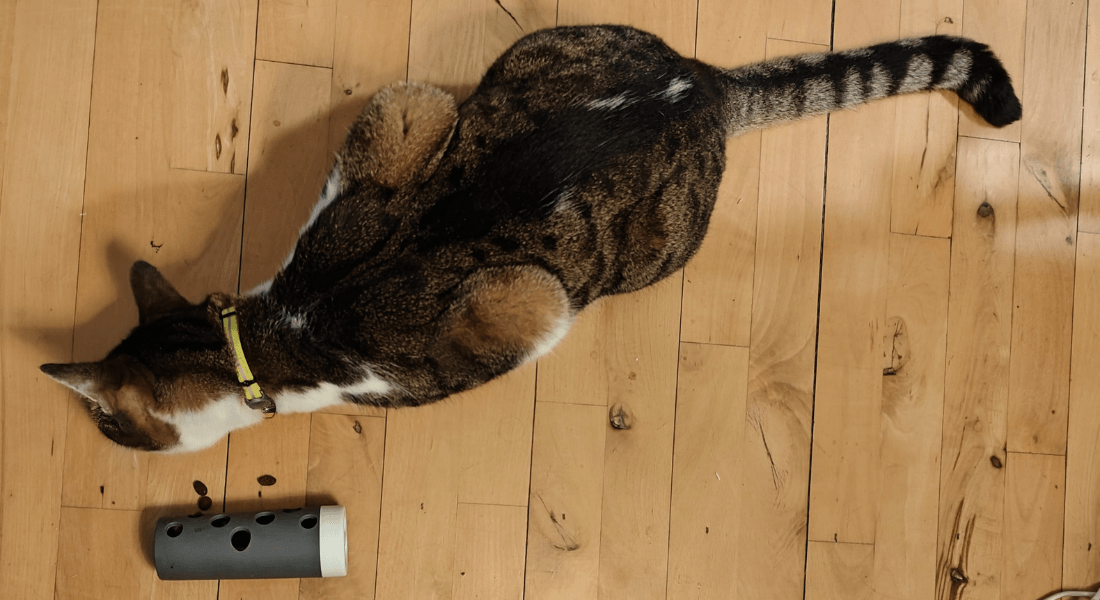
Full title: Dealing with annoying cats: A randomised controlled trial of feeding-time enrichment to reduce attention-seeking feline behaviours
Ayoe Hoff, Laura Sofie Römmelmayer Lundegaard, Mathilde Luth Møller-Petersen, Søren Saxmose Nielsen and Peter Sandøe,
Applied Animal Behaviour Science, April 2026
Abstract
Domestic cats (Felis catus) are increasingly popular as companion animals in the Western world. But the close interaction between cats and people inside the home can also generate problems. One important behavioural problem for companion cats is excessive owner-directed attention-seeking behaviour. This behaviour can be observed for cats with or without outdoor access but is probably more prevalent in indoor-only cats, likely due to their increased risk of experiencing unmet environmental needs relative to cats with outdoor access. While it is not inherently problematic for cats to engage with and seek attention from their owners as this is crucial to the communication between them, this type of behaviour can escalate if a cat does not receive enough mental and physical stimulation. One approach suggested by cat professionals to prevent or mitigate excessive attention-seeking behaviour is to provide various types of enrichment, including enrichment through food puzzles. However, to date, no studies have investigated the effect of such enrichment on attention-seeking behaviour.
Therefore, the aim of this study was to investigate the effect of enrichment in the form of (i) non-food-related object play and (ii) food puzzles on owner-directed attention-seeking behaviour among companion cats with no or limited outdoor access. A two-arm randomised controlled trial comparing the two enrichment interventions was conducted over a four-week period for 92 privately owned companion cats reported to display one or more predefined attention-seeking behaviours daily. The cats were divided randomly into two groups, one provided with food puzzles (44 cats) and one provided with non-food-related toys (48 cats). Owners in both groups were asked to use the items at their cats’ feeding times, and to report the prevalence of the cats’ attention-seeking behaviour weekly. The implementation of both enrichment interventions was associated with an observed decrease in most of the included attention-seeking behaviours over the study period. However, there was no significant difference between the two types of enrichment in how much the frequency of the included attention-seeking behaviours decreased. This suggests that consistent enrichment in connection with feeding may be a possible solution for attention-seeking behaviour in cats, and that object play and food puzzles can be used interchangeably.
Keywords
Aggression, Behavioural problems, Domestic cat, Enrichment, Felis catus, Food puzzles, Meowing
Highlights
- A prevalent behavioural issue among companion cats is attention-seeking behaviour
- We focused on indoor-only domestic cats as these likely lack stimulation
- We tested the effect of feeding-related enrichment on attention-seeking behaviour
- Enrichment reduced attention-seeking behaviour over a four-week study period
- Change in attention-seeking did not differ between non-food toys and food puzzles
Dealing with annoying cats: A randomised controlled trial of feeding-time enrichment to reduce attention-seeking feline behaviours (read the full article)