
The social competences of companion cats
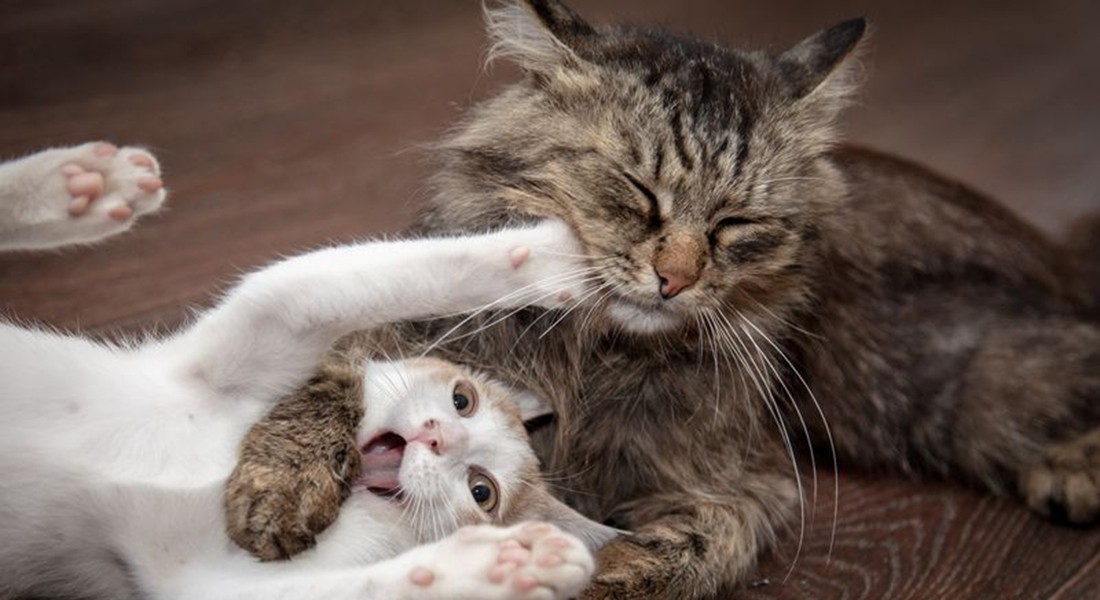
A representative study of the welfare of cats in single versus multi-cat households
Research article by Ayoe Hoff, Irena Czycholl, Thomas Bøker Lund, Daniel Mills, James Serpell and Peter Sandøe.
Applied Animal Behaviour Science, May 2026.
Highlights
- The welfare of cohabiting vs. singly-housed companion cats is still being discussed
- We tested the link between number of cats, other relevant factors, and cat welfare
- Increasing number of cohabiting cats was associated with reduced welfare
- Unrestricted outdoor access can reduce welfare issues among cohabiting cats
- Behaviour characteristics may partly explain reduced welfare of cohabiting cats
Abstract
Whether it is better for the welfare of companion cats to be housed alone or together with conspecifics is a subject of ongoing debate. There are conflicting results regarding the relationship between number of cats in households and cat welfare. However, the number of cats in the home is just one of many environmental factors, alongside cat and human characteristics, that influence individual cat welfare. Possible factors of importance include degree of outdoor access, cat demographics (age, breed, sex), owner-reported cat behavioural characteristics and access to welfare-relevant resources (litter trays, feed stations, water, resting, hiding places etc.). Based on a cross-sectional, representative sample of Danish cat owners this paper uses bivariate analyses together with multivariate regression analyses to investigate (i) to what degree the number of cats in a household relates to cat welfare (where welfare is measured through the prevalence of four health problems and eleven behavioural indicators), (ii) how other cat-related and husbandry factors (access outdoors and to welfare-relevant resources) correlate with the welfare of companion cats, and (iii) whether the importance of these husbandry and cat-related factors vary with whether cats are from single- or multi-cat households. For the cats included in the sample we find that: (i) increasing risk of health problems, house soiling and spraying is associated with an increasing number of cats in the home, (ii) decreasing risk of most negative welfare outcomes is associated with unrestricted outdoor access, and (iii) cats described by their owners as being more indifferent, not playful, inactive, nervous, reserved and fearful are more likely to have compromised welfare. Regarding differences between cats from single and multi-cat households, we find that: (i) unrestricted outdoor access is associated with reduced risk of the welfare concerns to a greater extent for cats from multi-cat households, compared to cats from single-cat households, (ii) cats from multi-cat households who are described as indifferent, not playful and inactive are more likely to have compromised welfare, compared to cats with similar behavioural characteristics from single-cat households, and (iii) cats from single-cat households who are described as being nervous, reserved and fearful, are more likely to have welfare issues, compared to cats with similar behavioual characteristics from multi-cat households. Our study highlights the complex nature of the relationship between individuals, their environment and welfare, increasing our understanding of the specific and inter-related factors associated with the welfare of cats from both single and multi-cat households.
Read the full article The social competences of companion cats – A representative study of the welfare of cats in single versus multi-cat households